
The RBI recently met with a handful of foreign banks and asked them to stop acting as market-makers for rupee NDFs, according to three bankers involved in the discussions.

Weakness of dollar in the overseas market also boosted the rupee value.
A weak dollar in overseas markets also strengthened the rupee sentiment
Tracking a steep fall in local share market, the Indian rupee on Tuesday washed out initial gains and ended with a loss of 16 paise

Finance minister Nirmala Sitharaman on Wednesday exuded confidence that inflation would further decline and the government is on track to meet its budgetary target for deficit and said that there is no fear of stagflation in India. Replying to the debate on first batch of Supplementary Demands for Grants 2022-23 in Lok Sabha, the finance minister said inflation has come down and it is now in the tolerable band of the RBI. Inflation has been declining since April 2022 and it is declining further, she said.

The rupee ended marginally higher by two paise at 62.24 against the dollar on Wednesday.
Foreign fund inflows and a higher opening in the domestic equity market supported the domestic unit

In the forward market, the premium for dollar moved up on fresh paying pressure corporates.
The rupee on Tuesday gained 29 paise to close at seven-month high of 60.48 against the dollar on sustained selling of the US currency by exporters and banks.

The rupee recovered from initial losses against the US dollar and was quoted barely steady at 61.91 on selling of the American currency by banks and exporters on good foreign capital inflows.

As the Indian currency hovers around its lowest versus the US greenback, several smaller and mid-sized companies are expected to face rough weather as almost 44 per cent of the foreign loans taken by Indian companies remained unhedged. According to the data sourced from the Reserve Bank of India, Indian companies raised around $38.2 billion in the financial year ended in March. Of this, only 56 per cent of the loans are hedged while the rest of the foreign loans remain unhedged, thus risking the companies to forex volatility.

A weak dollar overseas supported the rupee sentiment.

The rupee recovered from initial losses against the American currency and was quoted higher by 6 paise to 62.00 on fresh selling of dollars by banks and exporters in view of strong foreign capital inflows into equity market.

Officials said Sebi is closely in touch with RBI on the market developments.

The rupee extended its losses and slumped 10 paise to close at a record low of 77.72 (provisional) against the US dollar on Thursday, weighed down by a negative trend in domestic equities and unabated foreign fund outflows. At the interbank foreign exchange market, the rupee opened lower at 77.72 against the greenback, and finally settled for the day at 77.72, down 10 paise over its previous close. During the trading session, the rupee touched an intra-day low of 77.76 and a high of 77.63.

Dealers attributed the rupee's fall to increased demand for the US currency from importers.

Although the current long-term bullish trend is intact, markets are awaiting clarity on the taper and the Assembly election results.

The rupee resumed lower at 63.65 per dollar as against previous closing of 63.58 at the Interbank Foreign Exchange (Forex) market.

Even the persistent rise in equity market failed to restrict the rupee's fall.

Gold prices rebounded by Rs 190 to Rs 31,000 per ten grams in the national capital today on pick up in festive season demand.

After a a steep fall last week, the rupee has closed slightly stronger against the dollar.

The rupee continued to slide against the pound sterling and finished at 102.64 as against 102.25 previously.
The rupee had dropped 15 paise or 0.22 per cent yesterday.

The Indian rupee is expected to trade between 80 and 84 against dollar in the first three months of 2023 with support from overseas inflows though worsening current account deficit (CAD) and reduced interest rate differential between the US and India pose challenges. According to a Business Standard Poll of 10 participants, most said the rupee could gain strength in January due to foreign inflows, and the Reserve Bank of India (RBI) is not expected to allow the currency to depreciate ahead of the Union Budget scheduled on February 1. The rupee depreciated 10.15 per cent in 2022, its worst performance since 2013 as the war in Europe and the interest rate increase by the US Federal Reserve prompted investors to flee emerging markets.

Silver also rose sharply by Rs 640 to Rs 35,700 per kg.

Lower crude oil prices and a rally in domestic equities restricted the losses to some extent, forex dealers said. At the interbank foreign exchange market, the domestic currency opened weak at 79.50 per dollar.
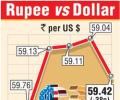
Forex dealers will keenly watch, instead, if the central bank indicates more measures to stabilise the currency or gives a timeframe for its current action.

Heavy dollar selling by banks and exporters alongside debt-related inflows largely supported the rupee

Given the stability of the rupee over the last 10 months, many companies have been tempted not to hedge their foreign currency risk.

Reserve Bank Governor Shaktikanta Das on Wednesday said in the wake of appreciating US dollar, the movement of rupee has remained least disruptive as compared to its peers, and the size of foreign exchange reserve is comfortable. On a financial year basis (from April to October 2022), the rupee has appreciated by 3.2 per cent in real terms, even as several major currencies have depreciated, he said while announcing the latest set of bi-monthly monetary policy. "The story of the rupee has been one of India's resilience and stability," the Governor said while pointing out that the appreciation of the US dollar this year, which precipitated large-scale depreciation of all major global currencies including the Indian rupee, has drawn wide attention.

A weak dollar sentiment across the board alongside unwinding of long positions by speculative traders ahead of key US macro data release largely supported the rupee

Weakness in dollar in the overseas market also boosted the rupee value

The rupee ended marginally lower by three paise at 66.36 against the US dollar.

The rupee on Friday snapped its two-day gaining streak against the US dollar.

In order to contain Current Account Deficit and arrest value of declining rupee, the RBI last month had raised the cost of borrowing for banks and reduced availability of funds to curb speculation in the forex market.

The Reserve Bank of India's (RBI's) outstanding net forward purchases of US dollars fell by more than 50 per cent from the last quarter of FY22 to $30.86 billion in the June quarter (Q1). The net forwards position was at $65.79 billion at the end of the last fiscal year. The purchases fell by $18.33 billion in June as the central bank intervened in both the forwards and the spot market in order to protect the rupee from excessive depreciation in the face of a widening trade deficit.

Bucking a strong trend in share market, the Indian rupee on Monday gave up all its initial gains and slipped 18 paise to close at 61.94 against the Greenback on rising dollar demand from importers.

Silver regained the Rs 35,000 per kg mark by gaining Rs 660.

This is the biggest one-day fall in the rupee since August 3, 2016

Unwinding of long-dollar positions by speculative traders and the currency's strong underlying fundamentals buoyed the home unit
